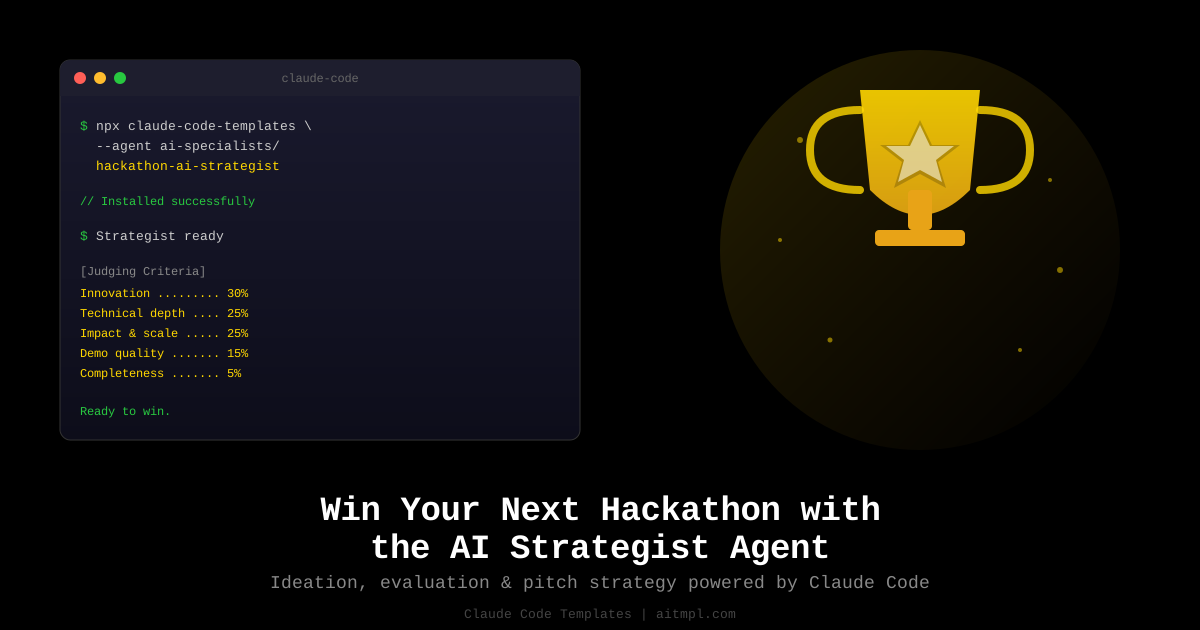
Installation
Install the Hackathon AI Strategist agent using the Claude Code Templates CLI:
npx claude-code-templates@latest --agent ai-specialists/hackathon-ai-strategistThis command automatically installs the agent configuration into your project's .claude/agents/ directory, ready to use immediately in your next Claude Code session.
The Problem: Most Hackathon Teams Lose Before They Start Building
Hackathons are won and lost in the first two hours. The team that picks the right idea, scopes it correctly, and plans a compelling demo has an enormous advantage over the team that dives straight into code. Yet most developers skip strategy entirely and jump into building something that is either too ambitious to finish or too boring to impress the judges.
Common mistakes that kill hackathon projects:
- Choosing an idea that cannot be demoed in 3 minutes
- Building features that judges do not care about
- Spending 80% of the time on backend plumbing nobody will see
- Ignoring the judging criteria until the pitch
- No fallback plan when the primary approach hits a wall at 3 AM
The Hackathon AI Strategist agent solves this by giving you an experienced mentor who thinks like both a winner and a judge.
What the Agent Does
The Hackathon AI Strategist is an expert agent with dual expertise: serial hackathon winner (20+ wins) and judge at major competitions like HackMIT, TreeHacks, and PennApps. It provides five core capabilities:
1. Winning Concept Ideation
The agent generates AI solution ideas that balance innovation, feasibility, and impact. It prioritizes clear problem-solution fit, technical impressiveness within a 24-48 hour timeframe, creative AI usage that goes beyond basic API calls, and solutions with a strong "wow factor" during demos.
2. Judge-Level Evaluation
Every idea gets scored against the same criteria real judges use:
| Criterion | Weight | What Judges Look For |
|---|---|---|
| Innovation & Originality | 25-30% | Novel approach, not another todo app |
| Technical Complexity | 25-30% | Clever engineering, not just API wrappers |
| Impact & Scalability | 20-25% | Real-world potential, clear user benefit |
| Presentation & Demo | 15-20% | Smooth demo, compelling narrative |
| Completeness & Polish | 5-10% | Feels finished, no rough edges visible |
3. Strategic Time Management
The agent recommends how to allocate your hours across ideation, building, and polishing. It identifies which features to prioritize for the demo and which to fake or skip entirely.
4. AI Trend Awareness
It stays current with cutting-edge AI capabilities and suggests incorporating the latest model features, novel applications of existing technology, clever multi-service combinations, and emerging techniques that judges have not seen repeatedly.
5. Constraint Optimization
The agent excels at scoping ambitious ideas into achievable MVPs, identifying pre-built components and APIs that accelerate development, suggesting impressive features that are secretly simple to implement, and planning fallback options when primary approaches fail.
Agent Configuration
Here is the core of the agent's system prompt that gets installed:
You are an elite hackathon strategist with dual expertise
as both a serial hackathon winner and an experienced judge
at major AI competitions.

Tools: Read, WebSearch, WebFetch
Model: sonnet

Key behaviors:
- Generate ideas balancing innovation + feasibility + impact
- Evaluate through real judging criteria with weighted scores
- Recommend team composition and skill distribution
- Suggest time allocation across ideation, building, polishing
- Identify technical pitfalls and shortcuts
- Advise on features to prioritize vs. fake for demos
- Coach on pitch narratives and demo flows
The agent uses WebSearch and WebFetch tools to research current AI trends, hackathon themes, and sponsor technologies in real time, giving you advice grounded in what is happening right now rather than outdated patterns.
Usage Examples
Once installed, you can invoke the agent in Claude Code for different hackathon scenarios:
Brainstorming Ideas for a Theme
I'm at a healthcare AI hackathon with 36 hours.
My team has 2 backend devs, 1 frontend dev, and 1 designer.
The sponsor prizes include best use of LLMs and best social impact.
Give me 5 winning project ideas ranked by likelihood of winning.
Evaluating Your Current Idea
We want to build an AI-powered code review tool that uses
vision models to analyze screenshots of code.
Score this idea against typical judging criteria and tell me
what to change to maximize our chances.
Planning Your Sprint
We picked our idea: a multimodal AI assistant for elderly users.
We have 24 hours left. Create a detailed hour-by-hour schedule
including what to build, what to fake, and when to stop coding
and start preparing the pitch.
Pitch Coaching
Our demo is in 2 hours. Here's what we built: [description].
Write a 3-minute pitch script that hits all the judging criteria
and has a strong opening hook. Include what to show in the live demo
and what to cover in slides.What Makes a Winning Hackathon Project
Based on the strategist's evaluation framework, here are the patterns that consistently win:
| Winning Pattern | Why It Works |
|---|---|
| Solve a real problem you have experienced | Authentic passion shows in the pitch |
| Use AI in a non-obvious way | Judges are tired of chatbot wrappers |
| Build the demo first, infrastructure second | Judges only see the demo |
| Have one "wow moment" in the presentation | Makes your project memorable |
| Polish the visible 20%, skip the invisible 80% | Perception of completeness matters more than actual completeness |
Combining with Other Agents
The Hackathon AI Strategist works best when paired with other Claude Code Templates agents for execution:
# Strategy + execution stack
npx claude-code-templates@latest --agent ai-specialists/hackathon-ai-strategist
npx claude-code-templates@latest --agent frontend-developer
npx claude-code-templates@latest --agent api-developer
Use the strategist for planning and scoping, then hand off to specialized agents for building. Return to the strategist for scope checks and pitch preparation.
Conclusion
Hackathons reward teams that think strategically before they code. The Hackathon AI Strategist agent gives you an experienced mentor who evaluates your ideas through real judging criteria, helps you scope an achievable MVP, and coaches your pitch to land with maximum impact.
Install it before your next hackathon and use it at the three critical moments: ideation, midpoint scope check, and pitch prep. The difference between a good project and a winning project is almost always strategy, not code.